Downtime: meditation, alcohol and cannabis

With an insanely busy work year in the rearview mirror coupled with a ramp-up in training intensity, my thoughts are pretty focused on recovery & relaxation right now. I like to think of myself as experienced in that area, knowing the key techniques and being “in tune” with my body’s needs. Trouble is – much like the gulf between feeling motivated to do something and actually doing it – I have a definite problem with execution. If all is right with the world, I’m not rushing around my day, I don’t have work anxiety and I get home before 7pm, I have a fighting chance of eating well, foam rolling and stretching, and waking up early enough to get my workouts in and not be wrecked tired. If not, I can head into a vicious cycle of fatigue and bad habits very quickly. Cue bourbon before bed, poor sleep, missed workouts, and lots of chocolate. Go me.

So, I’ve been working on putting in place some strategies to help me do better.
bike_beer_cannabis

Meditation

The first, and by far the most important for me, is meditation. I think of this like endurance training for my mind. I am in love with the Headspace app by Andy Puddicombe, which I’ve been using for a couple years now, although I’ve only just got consistent with it. I’m currently working my way through the Sleep module, which teaches you “resting awareness”, or put another way, enabling your active mind to sync up with your physical sense of restfulness and thus come to a natural place of rest. I’m finding that practice of this technique helps me in multiple ways:

  • coaxing my mind to a place of rest, rather than have it run around after one thought after another, whether anxious or pleasurable…this is getting me to sleep quicker – something I’ve struggled with my whole life
  • gives me a natural mental anchor during the day, when it’s easy to get lost in a sea of distraction. This in turn keeps my stress levels lower and I find I have less of a mental “climb-down” to do in the evening

Alcohol

Second, alcohol. Ah, what a pernicious pleasure. So many articles to choose from that talk about how bad it is! Let’s recap. Alcohol:

  • causes sleep fragmentation and suppresses REM sleep by putting you into a state of sedation as opposed to natural sleep
  • decreases muscle protein synthesis
  • reduces fat oxidation by allowing for preferential burning of acetate
  • lowers testosterone levels

OK fine, I get it, but I must admit I have completely given up trying to eliminate alcohol altogether, because – well, because I bloody well enjoy it from time to time, dammit. Especially beer after a long bike ride. And what’s that famous quote by Voltaire? “The perfect is the enemy of the good”. I think that applies here.

I do try to limit to just a small amount a few times a week. My strategies for achieving this are:

  • choosing CBD over alcohol post-workout (see below)
  • keeping alternatives around like non-alcoholic beer or spirits. For the former, note that it’s scientifically proven to aid with recovery. And I’ll be tasting some of these “athletic brewing” beers at some point for sure. For the latter, I ended up ordering a few bottles of Seedlip from Amazon today. It looks posh and sexy, so my hopes are up I get the psychological pleasure of drinking liquor, at least
  • aiming to avoid drink as a way to “shut down” my brain in the evening (this is where I’m most likely to fail – see meditation paragraph above)
  • buying really expensive stuff and decanting it, thus elevating its status to “something to be savored when you really fancy it”
  • mindfully enjoying, drinking as much as I would like – until my taste buds start rejecting it. In other words, I let my body dictate what’s enough. If it tastes good and goes down well, it’s all good…if not – then I’m done.

Cannabis

Third, CBD – and maybe THC, if you’re so inclined. Dude…

Brief primer. CBD is short for cannabidiol. It is one of the 113 chemical compounds, called cannabinoids, found in a Cannabis plant. The other key cannabinoid is called tetrahydrocannabinol, or THC for short; this is the principle psychoactive compound. Both marijuana and hemp are forms of the cannabis plant; the former is low in CBD and high in THC (up to 30%), and the reverse is true for the latter, with only trace amounts (<0.3%) of THC present. CBD acts to reduce the psychoactive effects of THC. It interacts with the body’s endocannabinoid system which is responsible for homeostasis within the cells of the body. Its specific benefits are:

  • anti-oxidant
  • anti-inflammatory
  • anti-anxiety
  • analgesic

A typical daily dose depends heavily on the individual, typically anywhere in the region 5-50mg.

My favorite time to take CBD for recovery is after my last weekend workout, post-stretch and shower, once my muscles and nervous system have calmed a bit. Then I get to “be one with the couch”. It gets me to that deeper level of relaxation, and I’ve never once had any side-effects. Recovery rides under the influence are also purported to be quite pleasant, allowing an enhanced connection to one’s physical & mental environment and an increased ability to be in the present. It’s worth stressing however, that finding what works for you in that regards should be an experiment of n = 1. That goes for cycling in particular, as – at least for non-habitual users – cannabis has been found to cause decreased reaction times, loss of precision, and a decreased ability to listen to your body – none of which is beneficial to a hard or technical ride!

There are real sponsorship synergies starting to develop between the worlds of cannabis and cycling, especially since WADA removed CBD from its list of banned substances in 2018.

In case you’re not already on the CBD bandwagon and would like to try it out, here are links to three of the better-known and reputable brands:

Bluebird Botanicals

Charlotte’s Web

Floyd’s of Leadville. The company also offers a traditional sports recovery drink infused with CBD.

Finally, if you’re in NYC and feeling fancy, you could always stop by the “Sephora of CBD”.

Conclusion

Wouldn’t it be great if you could drink a beer, but with all the benefits of cannabis and none of the drawbacks of alcohol?

Oh wait – you can…https://www.marketwatch.com/story/weed-beer-is-near-and-its-gonna-get-weird-2018-08-28.
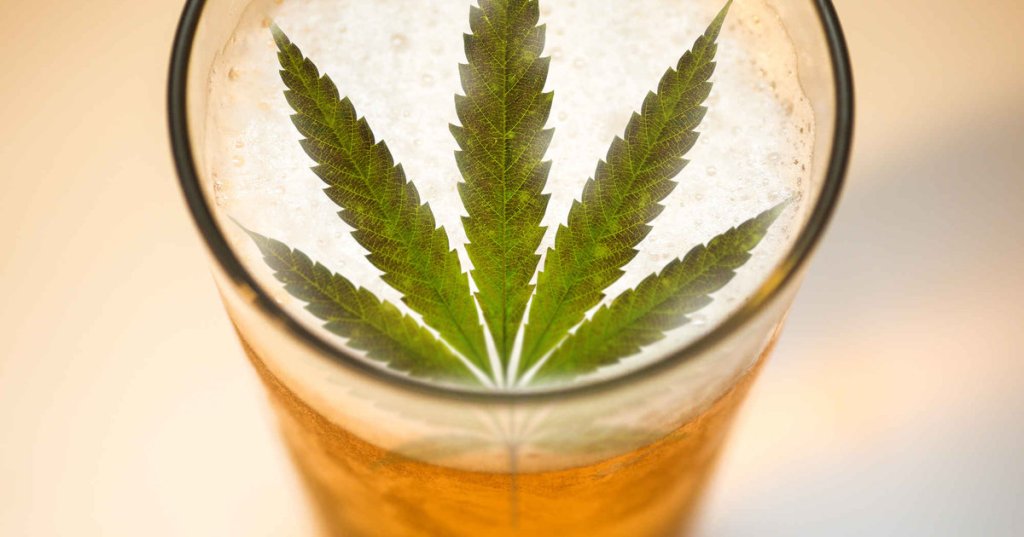
marijuana-infused beer

How To Train Your Husband, Part I

In the spirit of just pitching straight into things, I asked my husband if I could coach him for a month. This would have benefits for both me and him. On my side, it would act as a “test run” to get some insight into whether coaching was something I really would enjoy. On his side, he hasn’t trained for a long time but is starting with a real coach in February with a big race in the fall as his goal. A prep month would go a long way to getting him ready for that.

Success is not a foregone conclusion. My husband is a strong and accomplished triathlete, but his training has suffered the last couple of years from work-related stress and injuries. We have quite different personalities from an athletic perspective. I tend to be pretty gung-ho about seeing how far I can push myself, happy to cross that red line as a way of figuring out where it is. He on the other hand prefers to advance more cautiously, which I can find hard to understand. We went out for a run together a few months ago. We set out nice and easy, but he soon started walking, complaining of discomfort from lack of fitness. I’d seen this before and knew that cajoling him into running again hadn’t worked, and so – motivated by frustration – I thought I’d try the “tough love” approach instead and yelled at him “JUST SHUT UP AND RUN!”. Suffice it to say we did continue running, but in opposite directions. I clearly have a lot to learn.

Warning: wife-coach-in-training

So, with this experiment, I really needed to figure out what does work – what are his limiters, and how do I practically overcome them to get him to his goals. That started with a conversation about what a successful January would look like and what difficulties he’d had in the past to start training consistently again.

My husband was clear on his goals, so these were straightforward to list:

  1. Achieve some consistency of training again – specifically, two workouts per week for each swim/bike/run and strength
  2. Complete swim workouts of no less than 30 minutes each, and be able to swim 500-600m steady continuous
  3. Be able to run a minimum of 5 miles continuously, i.e., no walk-run
  4. Do not, under any circumstance, buy cheese

Now for the limiters. First question – what is your motivation? Why do you want to be doing triathlon in the first place? In the kind of sporty circle we move around in, I think it takes guts to answer that honestly. Doing an Ironman – or two, or three, and maybe even two or three per year – is business-as-usual for people we know. We all like to swap stories of how hard we’ve been training and how dedicated we are. It can easily become a part of our lives to which our core identity feels inextricably linked. To my husband’s credit, he said he’d thought long and hard about quitting…ultimately choosing not to because working out is something that brings him real joy, pure and simple.

Second question – given that the motivation is there, what is stopping him from working out? Why doesn’t wanting to get out the door in workout gear translate to actually doing it? Apart from the specific practical challenges that each person uniquely faces, in my experience just the entire mental and physical effort to shift from inertia to exercise cannot be overstated. The human body is like a car engine – once up and running it hums along, but if stopped for a while, the parts get stuck and become resistant to movement. If you’re busy, tired, and finding that workouts increasingly just cause physical misery, getting out the door is a huge accomplishment in and of itself. With a few additional questions, I came up with the following list of blocking points and ways to overcome them: –

  1. Make time for workouts by getting stricter on work hours. My husband is a true professional, successful and respected as someone who gets the job done well. Admirable as that is, it cannot mean he allows it to destroy his work-life balance
  2. Re-establish good workout routines by ensuring workout kit is prepped the night before. This routine is something my husband clearly associates with feeling good as it was a habit of his during his last successful training block. As minor as it seems, I wrote the time he needs to set aside to do this directly into his plan   
  3. Keep injury concerns off the table by ensuring a full warm-up routine and emphasizing flexibility as much as strength. For a run or strength workout of 1 hour, I specify the first 30 minutes to be foam rolling, dynamic stretches and/or form drills. That ratio should lessen over time
  4. Overcome negative self-talk – this is a big one for him. “What’s the point, I’ll never get my fitness back”; “I had a tough day at work, I really deserve to kick back with a beer”; “My muscles are sore, I’m going to get injured if I work out”…I turned to Sports Psychology for Dummies for help which advised to find a positive mantra to replace the negativity. We landed on “one step at a time” which I put as the title for all his run workouts and remind him of every time he heads out to train
  5. Keep motivation front and center by emphasizing the key objective of each workout is to have fun – go play! Mountain biking, running off the main central park loop, all welcome. No watches, heart rate monitors or power meters allowed

As of tonight, we’re about a week in to training and I would say it’s going fairly well. Luckily for me my husband’s a good sport and of course wants my experiment to be successful, which is a bit of a cheat, but I’ll take it! Results to follow.

So, what’s this blog about?

In a recent conversation with my bike coach, we got to talking about focus versus observation. I was about to participate in my first ever mountain bike race and was deeply scared of crashing.

“What’s making you scared?”

“There are so many ways I can fall. My tire can skid out in the mud or hit a tree root at the wrong angle. I find it really hard to look out for all those things yet maintain any kind of speed.”

“How far ahead do you look while you’re biking?”

“I look down, right next to my front wheel.”

Of course, that was the crux of it. I was too focused on each little obstacle as it came up and not looking far enough ahead to scan for them in advance. Coach explained that this anticipation was key to achieving a state of “flow”.

Ever since I was a child, I’ve been looking at my feet. I still remember my mother constantly telling me to pick my head up as we’d walk down the street. I’ve always been “in my own head” and studied abstract math at university. My husband has tried and failed multiple times to explain to me the difference between an “SUV” and a “minivan” – all I see is a “big car”.

In short – I can focus through any and all distractions, but my observation skills are lousy. So, I’ve been learning to pick my head up – both on the bike and for life in general.

Not that I’m remotely depressed but you can’t beat this Charlie Brown strip for a better summary of mind-body interaction:

charlie brown posture

Why that has anything to do with my career

I started out as a runner, moving into triathlon a few years ago & doing the whole Ironman thing, before jumping into bike racing to improve my handling skills. I only meant to do one or two races, but that was nearly two years ago and I’ve ended up staying…

I believe that one of the great pleasures in life is being around people who inject you with enthusiasm on any given topic, no matter your prior interest. I’ve been lucky enough to find such people in the biking world and have become hooked. It’s this gorgeous blend of art, science and guts and I’m absolutely loving it. From optimal position on the bike, to positioning for the sprint, to tensioning wheel spokes – I’m learning whatever I can, when I can.

Meantime, I spent the summer working like crazy in my day job to get a new process up and running. This meant emerging from my little analytical shell to influence and promote across multiple divisions, as well as to guide and motivate my young team. Achieving success felt like I’d been given new superpowers…I realized I could do more than I had thought possible. Specifically it got me thinking that maybe I could “go it alone” one day, and maybe I could take elements of what I enjoy the most to build my own business, and maybe some of those elements could be bike coaching and bike fitting and writing…let’s see…eyes up, look ahead!