I was recently struck by a confluence of
lessons learned between my strength training and my career development,
specifically in relation to pushing through difficult situations.
Wednesday evening I had strength – heavy
lifting. I work hard on my strength technique. I like to think I know what good
posture looks like and how to implement it. This evening was a total fail,
however. I was given a new type of dynamic workout – I had to leap forward, landing
on one leg then the next, keeping total stability to land balanced before
immediately generating power for the next leap. With a resistance band around
my ankles. This is hard…if you don’t have core locked, hips aligned, butt
engaged, knees bent, chest up AND trailing leg activated then from what I can
tell, you’re basically going to either fall over or not really go anywhere fast
in a forward direction.
“I don’t get why I’m so unstable”,
I moaned to my trainer. “In my head I’m doing all these things, so why am
I so rubbish?”
“Well, a) you’re actually not doing all
those things, and b) you’re trying to muscle through the movement instead of
locking your posture in and using it to generate momentum. So, you’re losing
power and stability left right and center.”
Well phooey. So much for having great
technique. One ratchet up in exercise difficulty and suddenly I’m a wobbly mess.
The next day, I had a one-on-one with my
boss. I’m up for promotion to Director this year; I wanted his feedback on
where I needed to improve in order to be effective in such a role. He pointed
out that while my tenacity and drive were strong, my ability to accommodate
deviations from my intended plans was weak. In other words, I needed to get
more creative about overcoming obstacles, as opposed to just ramming against
them as hard as possible in the hope they’d eventually collapse.
Hmmm. That sounds familiar…. is that a little
theme emerging? Muscle versus technique…clearly you need both, but the former
will only get you so far. A stationary position allows force to overcome a
myriad of weak links. Add in a dynamic environment – competing priorities, shifting
objectives, difficult colleagues, plyometric jumps…and those links will get
tested. In the context of strength, these are posture and flexibility. In the
context of work, these are communication and adaptability. In both cases, having
a strong core, or center, and finding calmness at that center is key. I think
of it a bit like being in a hurricane. You want to be in the eye of the storm,
not the swirling clouds.
I’ve learned that curiosity is the key to
keeping that center. Acknowledge and try to understand the problem, don’t try
to fight it. Put another way, it moves the conversation away from “this so
hard for me” (negative) towards “why
is this so hard for me and how do I overcome it” (positive). Sometimes,
that may mean taking a couple of steps back before you can move forward again. But
that’s OK.
In the end, I spent about half our one-on-one
waxing lyrical about the parallels between work, cycling and strength. Happily,
my boss didn’t seem to mind too much.
Of all the training questions I’ve had over the years, this one
has plagued me the most in one form or another. I’d have these beautifully
laid-out plans of run, swim and bike workouts all spaced out perfectly for
recovery purposes, and then I’d remember I had to get strength in there somehow
and the whole week would get screwed up. Was I supposed to do that the same day
as a hard workout? Next day? How many reps?
Up until last week I thought I’d got that figured that out. In
my running and triathlon days, endurance was the name of the game. The
objective of strength work in the gym was to buffer against injury and increase
resistance to fatigue. This is also called building “muscular endurance” and is
typified by sets with relatively higher reps and lower weights. Coming into
workouts with some muscle fatigue is normal, provided recovery is adequately accounted
for.
Such strength work fits in nicely with a classic pyramid training
plan which starts with a “base” period where you build your basic fitness – get
an aerobic base, build strength as described above, and work on “speed skills”
i.e. sport-specific drills where you work on technique and cadence to help you
gain efficiency. As base progresses to “build” and “race” phases, longer and/or
harder sport-specific workouts take precedence, and strength work in the gym goes
on the back burner. I’d normally find that during springtime I’d hit a week
where I’d get really fatigued trying to do a lot of everything and crash. This
was my signal it was time to cut back strength to once-a-week maintenance.
Perfect.
This off-season however, three things are different. First, I’m
bike racing, not triathlon-focused. Second, I got flexible and strong enough to
start lifting some proper heavy weights. Third, my coach flipped the classic
pyramid on me. This means we’ve been working on my limiter – the short end of the
power curve – with hard interval workouts during my “base” period.
Always the one to push, of course I tried to “Keep Calm and Do Everything”.
I need to do strength or I’ll be weak! Going into hard intervals fatigued? Well
that’s normal, isn’t it? Doesn’t that just mean I’ll ultimately be stronger? I
checked with my coach and my trainer.
Coach (still getting used to me): “Uhhhhh no, I need you fresh
for the hard stuff. Sorry…why did you put an extra strength workout in your
plan?”
Trainer (known me for years): “No. LOL, you always try to do too
much, you’re hilarious…”
OK then…time to go away and figure out where my thinking went
wrong. Here’s a summary of what I learned.
Wikipedia defines muscle fatigue as follows: “Muscle fatigue is the decline in ability of a muscle to generate force. There are two main causes of muscle fatigue: the limitations of a nerve’s ability to generate a sustained signal (neural fatigue) and the reduced ability of the muscle fiber to contract (metabolic fatigue).” Metabolic fatigue is caused by two main factors: shortage of fuel and/or accumulation of metabolites (e.g. lactic acid) within the muscle fibers.
Strength can be defined as the “property of a person or thing that makes possible the exertion of force or the withstanding of strain, pressure, or attack”. Strength training is about developing the ability to generate force. That force can be generated by one or more of three types of muscle fibers: “slow-twitch” – Type I, or “fast-twitch” – Types IIa and IIb. Essentially, slow-twitch fibers use oxygen for fuel – i.e. they work “aerobically” – and this type of fueling allows the fibers to generate a moderate level of force for a sustained amount of time. Put another way, they are recruited when muscular endurance is required. Fast-twitch fibers use stored muscle glycogen for fuel instead of oxygen – i.e. they work “anaerobically”. Anaerobic fueling allows the fibers to generate high-intensity force, but only for a short period of time. They are recruited in order to generate power. Fast-twitch fibers only contract once the slow-twitch fibers have fatigued.
The
percentage of each type of fiber in your body depends on both genetics and how
they are developed in workouts. As explained by my trainer: “different strength
workouts are specifically measured by Time Under Tension, Duration, Repetition,
Load, and Speed. Relying on these measurements illustrates how the workout is
defined and which muscle fibers you’re firing off.” The table below summarizes the
differences between them in more detail.
Characteristics
of muscle fiber types
Characteristic
Type I
Type IIa
Type IIb
Contraction speed
Slow
Fast
Fast
Resistance to fatigue
High
Medium
Low
Force production
Low
High
High
Glycolytic capacity (ability to produce energy in the absence of oxygen)
Low
High
High
Oxidative capacity (ability to use oxygen as fuel)
High
Medium
Low
Recruitment during sport
Endurance
Mix
Power
Going back to the original question, then, where was my thinking
going wrong? – Essentially, I was confusing the development of endurance and
power. Type II muscle fibers won’t fire when they are fatigued, which means
that if I head into an interval workout with sore muscles, I will recruit more of
the Type I rather than Type II. This isn’t an absolute – depending on level of
fatigue I may end up using some percentage of all types – but if the objective
of the workout is to train power generation, it’s definitely less effective.
There is some nuance when it comes to putting a training plan together.
One thing that I did notice and is apparently a common experience, is that I can cope with two hard workouts on back-to-back
days with only a small loss in power. After that I’m toast, but provided I get
adequate recovery before the next hard session, it’s OK. Again reviewing this
with my trusty coach/trainer team, it seems this ability to cope with
back-to-backs is really personal to each athlete. I’ve been training for many years
now so maybe my overall resistance to fatigue has developed over time. In
addition, one needs to consider the cumulative impact of workouts, not just
what you did the day before. Two hard days at the end of an intense training
block likely feels quite different than at the start.
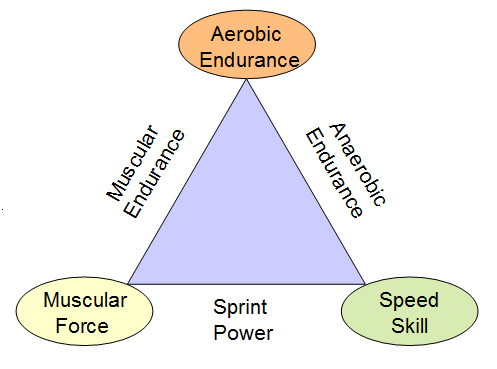
All the concepts above come together nicely in the diagram below, which is the well-known “6 abilities” triangle as used by Joe Friel in his Training Bible books.
Each of the advanced abilities shown on the sides depends on the basic
abilities shown in the corners. In particular: muscular endurance lies between the development of force and aerobic
endurance. It’s the capacity to maintain a relatively high force for a
relatively long time. Muscular power
lies at the intersection of force and rpm – Force * Cadence = Power.
 Eyes Up, Look Ahead