Learning about The Bike – where to start? It’s a pretty big subject…I faithfully use GCN Tech as my starting point, but I do like to dig deeper on various topics…then I end up tunneling around a rabbit warren-full of information and getting fully overwhelmed. So, I thought I’d start my first “technical” blog post with something as small as I can think of – brake cable tips – and see how many words I could get to.
I became unreasonably excited by cable tips during Tucson bike camp, where the mechanic noticed that I didn’t have one and gave me a red shiny replacement, which I loved because a) I hadn’t noticed their existence before and b) I didn’t realize such things could come in different colors. As a result, this is now officially the favorite thing about my bike.
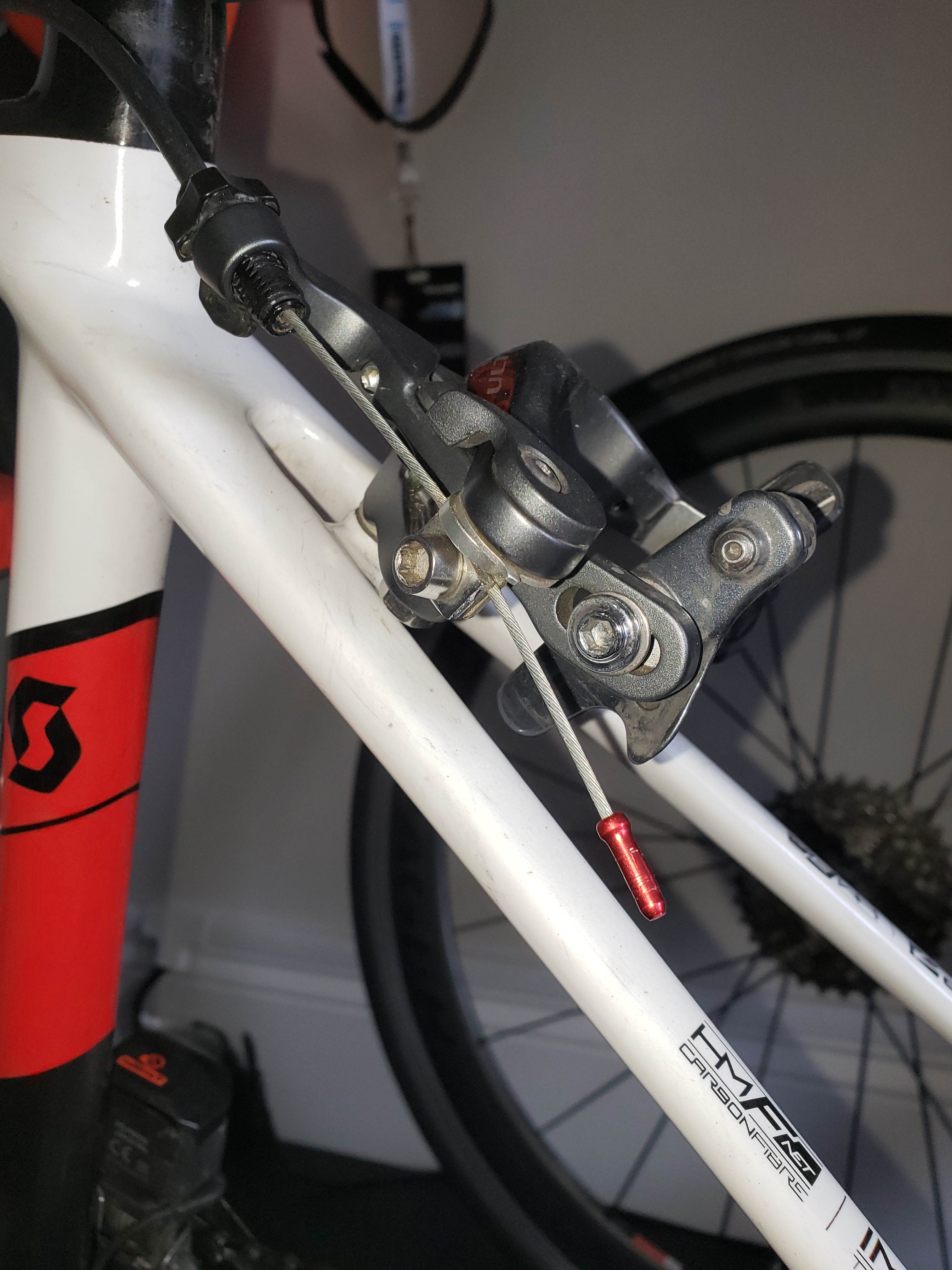
The very basics of bike cables
Bike cables – for both braking and shifting – are types of Bowden cable. They are comprised of an inner cable made of twisted strands of steel moving inside of an outer housing, also made from steel. The basic idea is that when you pull on the inner cable, it pushes against the housing, thus creating tension between the two and allowing the cable to move in a non-linear path between components. The housing also has a plastic liner which surrounds the inner wire and reduces friction between the two.
Cable tension is adjusted using the barrel adjuster, which lengthens or shortens the cable housing relative to a fixed point. Lengthening the housing forces the inner cable to travel further, effectively tightening it.
The traditional cable housing is comprised of steel wire wound into a helix (like a mini slinky); since this allows the length of the housing to change as it is flexed, it is a source of imprecise shifting. Thus, shift cables use a modified type called compressionless housing. This uses many inner support wires running parallel to the inner plastic liner, which prevent the length to change.
The housing will usually be encased in a plastic sheath to prevent corrosion.
The Jagwirewebsite has some nice diagrams of the different types of inner wires and cables available.
What are cable tips, and why do we need them?
A ferrule is defined most generally as “a ring or cap, typically a metal one, which strengthens the end of a handle, stick, or tube and prevents it from splitting or wearing.” Within the context of bike cables, a ferrule is a small cap which fits over the end of a piece of cable housing. It helps keep the housing aligned with the cable stop it fits into, for example the barrel adjuster. A brake cable end, or tip, is also a type of ferrule. Since the tip is normally affixed around the end of the wire by crimping, these are also referred to as “crimps”. Cable tips are typically made from aluminum.
A cable tip is important because it prevents the cable from fraying or unraveling and from scratching you.
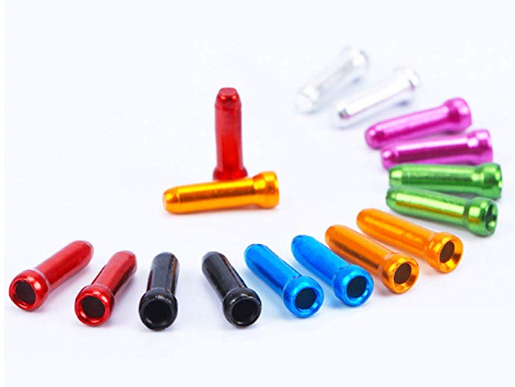
How to crimp a brake cable
Step 1. Thread inner brake cable through the barrel adjuster and the crimp part of the brake caliper; tighten to your preferred tension using the caliper bolt.
Step 2. Find an appropriate cable crimping tool:
- A dedicated crimping tool such as this one. This is if you really want to be neat and not deform the cable cap
- A cable and housing cutter with a built-in crimper like the CN-10 from Park Tool
- A pair of pliers
Step 3. Find some sexy-looking crimps in a color of your choice
Step 4. Crimp away! Fun fun fun
Crimp alternatives
The alternative to crimping is to solder the wire ends. The advantage of soldering over crimping is that it allows the cable to be pulled through the anchor bolt and housing to reinstall or re-lubricate it, rather than be removed and replaced with a new one every time you disassemble and reassemble a cable. The disadvantage is that the heat can weaken the steel, and it also seems somewhat less practical or simplistic. A second alternative I read about is to super glue the ends…but that just doesn’t seem like the elegant way to go.
Finally I did notice these fancy-looking cable tips from Yokozuna, which neatly finish off your cable ends without the need for any crimping at all.
Conclusion
So let’s see…a 778-word blog post on cable tips! Boom.
 Eyes Up, Look Ahead