All about brake cable tips

Learning about The Bike – where to start? It’s a pretty big subject…I faithfully use GCN Tech as my starting point, but I do like to dig deeper on various topics…then I end up tunneling around a rabbit warren-full of information and getting fully overwhelmed. So, I thought I’d start my first “technical” blog post with something as small as I can think of – brake cable tips – and see how many words I could get to.

I became unreasonably excited by cable tips during Tucson bike camp, where the mechanic noticed that I didn’t have one and gave me a red shiny replacement, which I loved because a) I hadn’t noticed their existence before and b) I didn’t realize such things could come in different colors. As a result, this is now officially the favorite thing about my bike.
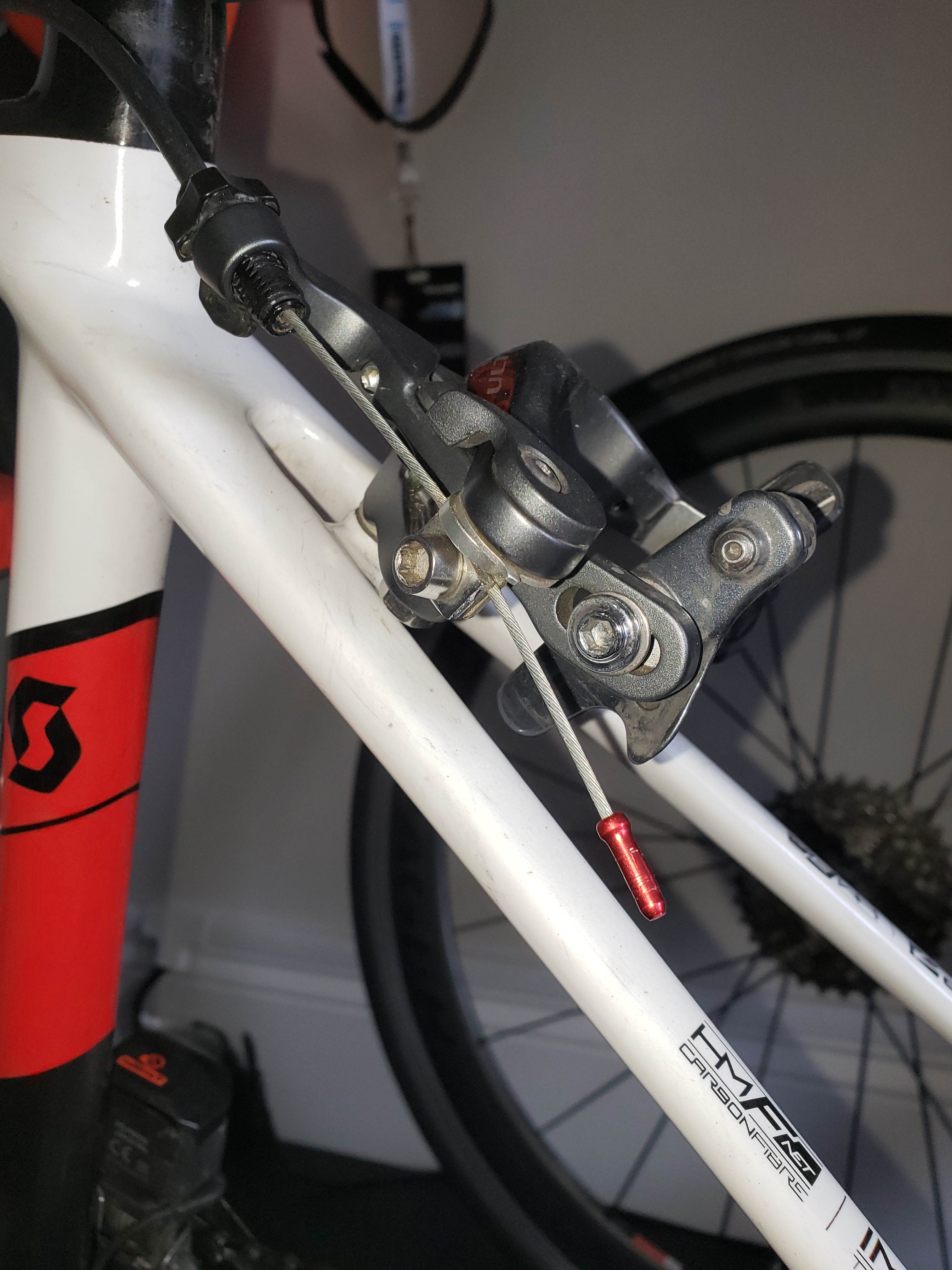
My brake cable tip – sexy or what??!!

The very basics of bike cables

Bike cables – for both braking and shifting – are types of Bowden cable. They are comprised of an inner cable made of twisted strands of steel moving inside of an outer housing, also made from steel. The basic idea is that when you pull on the inner cable, it pushes against the housing, thus creating tension between the two and allowing the cable to move in a non-linear path between components. The housing also has a plastic liner which surrounds the inner wire and reduces friction between the two.

Cable tension is adjusted using the barrel adjuster, which lengthens or shortens the cable housing relative to a fixed point. Lengthening the housing forces the inner cable to travel further, effectively tightening it.

The traditional cable housing is comprised of steel wire wound into a helix (like a mini slinky); since this allows the length of the housing to change as it is flexed, it is a source of imprecise shifting. Thus, shift cables use a modified type called compressionless housing. This uses many inner support wires running parallel to the inner plastic liner, which prevent the length to change.

The housing will usually be encased in a plastic sheath to prevent corrosion.

The Jagwirewebsite has some nice diagrams of the different types of inner wires and cables available.

What are cable tips, and why do we need them?

A ferrule is defined most generally as “a ring or cap, typically a metal one, which strengthens the end of a handle, stick, or tube and prevents it from splitting or wearing.” Within the context of bike cables, a ferrule is a small cap which fits over the end of a piece of cable housing. It helps keep the housing aligned with the cable stop it fits into, for example the barrel adjuster. A brake cable end, or tip, is also a type of ferrule. Since the tip is normally affixed around the end of the wire by crimping, these are also referred to as “crimps”. Cable tips are typically made from aluminum.

A cable tip is important because it prevents the cable from fraying or unraveling and from scratching you.
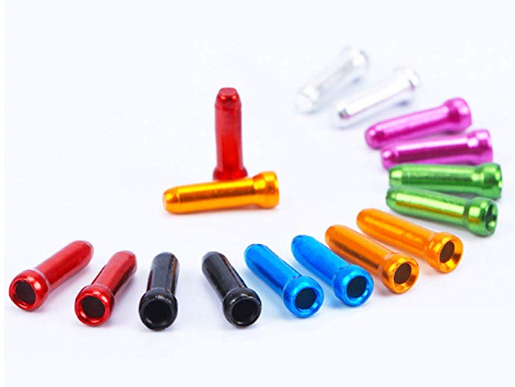
I love how some bright color makes these mundane little pieces fun

How to crimp a brake cable

Step 1. Thread inner brake cable through the barrel adjuster and the crimp part of the brake caliper; tighten to your preferred tension using the caliper bolt.

Step 2. Find an appropriate cable crimping tool:

  1. A dedicated crimping tool such as this one. This is if you really want to be neat and not deform the cable cap
  2. A cable and housing cutter with a built-in crimper like the CN-10 from Park Tool
  3. A pair of pliers

Step 3. Find some sexy-looking crimps in a color of your choice

Step 4. Crimp away! Fun fun fun

Crimp alternatives

The alternative to crimping is to solder the wire ends. The advantage of soldering over crimping is that it allows the cable to be pulled through the anchor bolt and housing to reinstall or re-lubricate it, rather than be removed and replaced with a new one every time you disassemble and reassemble a cable. The disadvantage is that the heat can weaken the steel, and it also seems somewhat less practical or simplistic. A second alternative I read about is to super glue the ends…but that just doesn’t seem like the elegant way to go.

Finally I did notice these fancy-looking cable tips from Yokozuna, which neatly finish off your cable ends without the need for any crimping at all.

Conclusion

So let’s see…a 778-word blog post on cable tips! Boom.
Why I’m falling in love with crit racing

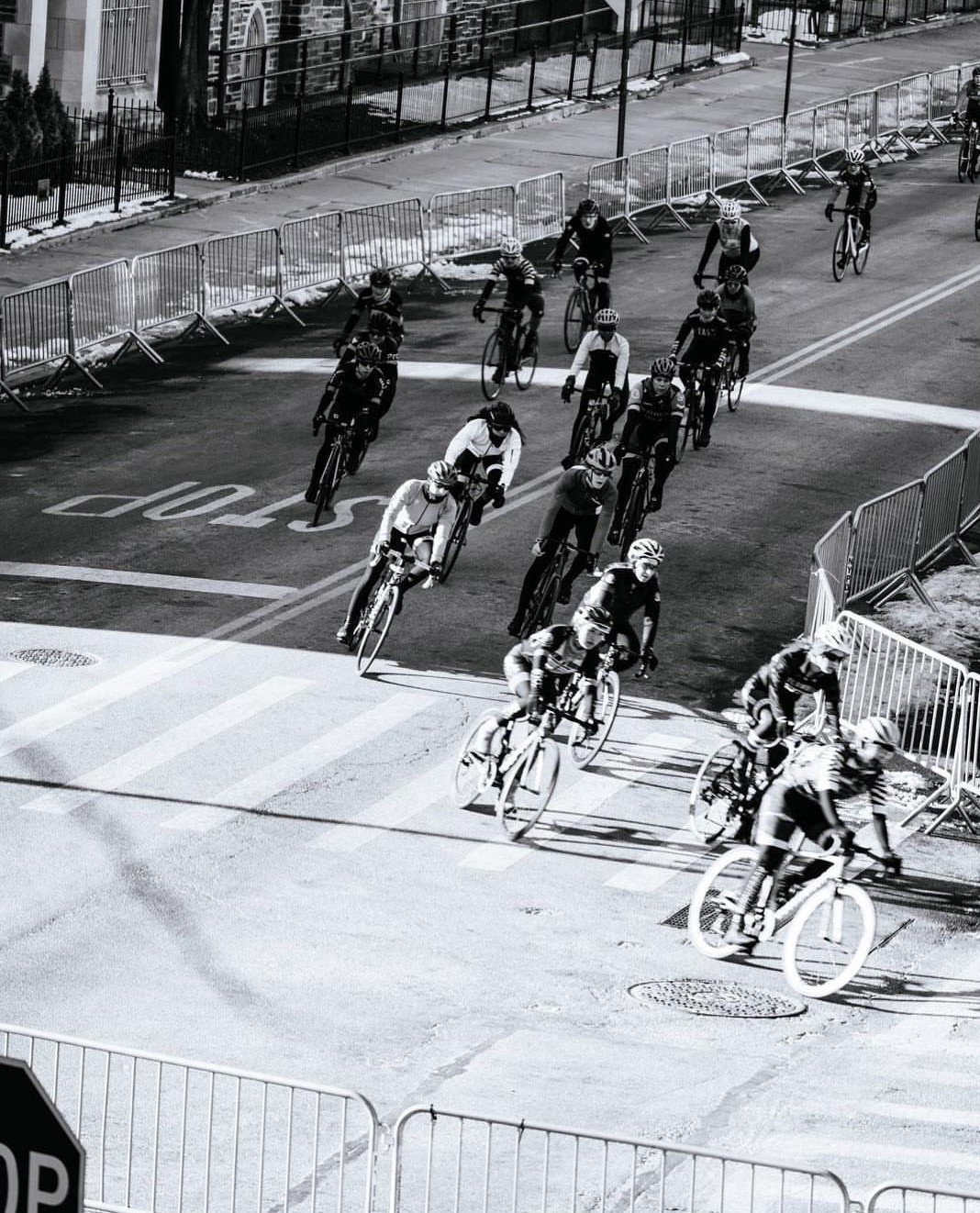
Rewind almost one year ago to the day, I was starting my first full season of biking and Grant’s Tomb Crit was the first race on the calendar. I’d never done a crit before, and yes, I was terrified – mostly of being unable to stay with the pack. I got to the start line of the Cat 4/5 race dead tired from the week, frigid cold (temps were sub-freezing) and not properly warmed up, thinking that somehow, I could do that during the race (?!). Two laps of blistering intensity and yoyo cornering action later, boom, off the back with my heart coming out of my chest. Luckily, I’m a stubborn little thing and – determined not to have that be my entire experience of a crit race – I got to the start line a second time for the Cat 3/4/5. This one felt easier, I guess because I was warmed up, but I still came pretty much last, and the blistering pace and technical nature of it still rattled my nervous system so much that I left the day with the same feeling I’d arrived with – utter dread of crit racing.

Fast forward to yesterday, and I’m back at the start line of Grant’s Tomb. The nerves were there but this time I felt more positive. I’d realized how strange it was that I used to have no problem killing myself in a 10k run race – in fact that was my favorite distance – but somehow on a bike I felt so much less “comfortable with uncomfortable”. I set myself two mantras for the day – “stay positive”, and “just like a 10k”. Combined with a year’s additional race experience, I did much better, not placing but staying near the front all race, taking corners smoothly, and only falling back on the last couple laps as I didn’t quite have the strength to stay in contention for the sprint.

I left happy! More importantly, I left wanting more. Eyes up look ahead? –no problem in a crit, easiest ask ever! I love how crits force you into the present so that all your senses awaken; and how they force you to breathe efficiently so neither your body nor nervous system crash. I love how technical it is and how every lap you get to figure out how to improve just that little bit more. The only price for admission is, as Steve Cullen from ButcherBox Cycling puts it in the funky short American Crit, “you just need to work so hard you wanna die”.

Grant’s Tomb Crit – I’m near the front and smiling

I love how this kind of race is so at home in the urban environment. I showed up at two more crits last year – Orchard Beach up in the Bronx – a chance to get some springtime sea air, and Lime Rock Grand Prix, a super fun course up in Connecticut. I got a kick out of the fact that’s a real car racing track – especially when I flatted and took a pit stop, where a mechanic changed out my wheel and pushed me back into the race! I’ll be trying a few more local ones this year, and I really hope Red Hook crit gets revived in 2020 for spectating purposes. There’s clearly a rich history of crits and a vibrant race scene in the U.S. that I’d love to see more of.

Teammates on the battlefield. The setting can’t be beat

As far as race goals are concerned, I developed well enough over the last year to go from “off the back” to “in the game”. This year I hope to progress to “in sprint contention”. My limiters are still fairly all-encompassing at this point:

  • 30s/1min power;
  • Sprint technique – I have a vague idea what to do but no experience and never practiced;
  • Improving my mental ability to push hard on a bike – even if my legs are learning to crank out higher power, my mind is still stuck in what I’ll call “Ironman mode”, where pacing is king and there’s really no need for a sprint finish, and certainly no need to go sprinting like a maniac in the middle of a race…

I also look forward to getting good enough to participate in the same race category as my teammates!

On the fun side, reading about Red Hook Crit, and more generally learning about track racing as part of my coaching study, has led me to sign up for an Introduction to Track Racing Clinic at Kissena Velodrome later this month. Give it a go, why not – and I’ll have to try at least one race after that.