Destination Tucson: why bike camp?

I know I’m supposed to be keen into anything and everything cycling, but the words “bike camp” fill me with dread. Yes, great base training bla-di-bla, but the night before leaving, I wondered what on earth I was doing. I’d willingly signed up for 7 hours of flying with all the uncertainty of connecting flights and 300 bucks worth of bike transport fees, to go bike for 3-6 hours a day for 5 days straight, including an ascent of Mount Lemmon. In a desert. Why? No really…so, I kept a mini diary in case it shed light on the matter.

Day 0

Glad I arrived early; I get to decompress although I want to try to build my own bike instead of waiting for the coaches to help. I’m mechanically challenged, but I get out my Ratchet Rocket Lite NTX and “give it a go”. I’m OK until the handlebars which take me 30 minutes with my husband on speakerphone and me sending him photos, “Does this look right to you? What are these long screws for?” Finally, success! Nice bit of confidence boost. I take a glass of wine and watch the sun go down.

Day 1

60-mile loop around Tucson. Nothing too hard to start with, it’s a perfect chance to wind up the legs and get to know my fellow riders. It’s great one of my teammates came; also, a couple ladies from a “rival” women’s team in the city – always happy to get to know my fellow racers better. Determined to save my legs I practice smooth drafting, but I keep gapping around corners and manage to spend 45 minutes in zones 4-6. Coaches take us through cornering skills at end of day to ready us for the descent of Mount Lemmon tomorrow; that’s a nice reminder but now I’m just worried about the ascent and then hanging on another 3 days.

Day 2

90 miles including a 7000ft ascent of Mount Lemmon over 29 miles. My coach can tell I’m nervous and he babysits me the first 10 miles, making sure I stick to zone 3 and distracting me with some good bike conversation. He leaves me in good spirits, but by the time I make it to our halfway SAG stop, I’m suffering. My breathing is ragged, I feel nauseous and can’t figure out why, and I’m upset because I seem to be going slower than last year. Coach 2 is biking up and down the mountain to check on everyone, asks if I’m OK, am I hydrating, eating…I tell him I’m fine and then I walk away from the van to hide a full-on anxiety attack. I tell myself to stay positive and just get the f*ck over it and with that in mind I start climbing again. A few minutes later I’m back with my coach, sitting on his wheel trying to find my own rhythm from his steady pace. But despite my best efforts I feel worse and start to slump over my bike. I make it to 8000ft before pulling over and crumpling on the asphalt, too short on breath.  

Coach helps me stand and gets me to box breathe. That calms me but I still feel sick as a dog. My teammate pulls up too and checks I’m OK, she’s ready to sabotage her own day and come back down with me if needed, but Coach won’t leave me anyway and we descend together.

Turns out to be the best descent I’ve ever made. Keen to salvage some biking joy from the mountain and with the cornering drills fresh in my mind, I push the nausea to one side and start hammering, playing around with the feel of controlling my lean and the lines. Maybe I’ll throw up but at least I’ll do it smiling.

At the bottom, Coach gets me to hydrate and then we pedal home easy together, sometimes chatting, sometimes him pulling me through the headwinds. If he was ever worried in all this, he never showed it.

Altitude sickness – who knew? There’s another notch of experience to put on my belt. Best ride fail ever.

Day 3

Today is scheduled for the Tucson shootout followed by a climb up Madeira Canyon, but I’m still feeling sick so I get some extra sleep & pedal easy for a couple hours by myself, exploring downtown. With the sun on my face and no pressure on pace I finally start to relax. There’s a coach’s roundtable discussion in the evening where the camp mechanic talks about learning to listen to your bike as closely as you do to your body. That’s gold dust advice right there; it makes me appreciate how much of a bike novice I am right now; I vow to improve.

Day 4

I wake up chipper and ready for some fun! The day’s ride is 70 miles to Saguaro West and do the 8-mile loop a few times. I follow the coaches around…we talk cornering and crit skills and what I can work on to stay smooth and use less watts. Then I sit in a close draft and make them bike really fast so my pigtails go flying behind me and I’m still barely working. Just like a playground ride!

Day 5

50 miles around Saguaro East. Yeah, I’m done – this is Eyes Up, Look Ahead and Bike Slow day. Actually, these cacti are growing on me. I’m from Wales and more of a rugged-green scenery kind of girl, but I finally start to appreciate the otherworldly beauty and how the stark difference to my usual NY routes feels refreshing to my mind. Today has a bike touring – not training – feel.

Conclusion

Why bike camp? Because it was a great learning experience; it has super-experienced coaches and a mechanic who are skilled at spotting and handling any kind of issue effectively without drama; it teaches you to get through that tunnel of fatigue and out the other side and still be pedaling strong; because a forest of cacti is actually pretty cool and because it captures everything that biking should be.

Thanks to enduranceWERX for a smashing bike camp.
Prehab not Rehab: a simple program to avoid injury and generate more power

Imagine you have the choice of purchasing two used cars. They’re both the exact same type, engine size and age, but one has been serviced more than the other – for example it has better wheel alignment and the pistons and sparkplugs are less worn. Naturally, we would choose to buy the better serviced car as the risk of breaking down is lower and we’d expect a more efficient use of fuel. So, why settle for less when it comes to our own body?

In human equivalent, we’re talking about the movement of joints and soft tissues – muscles and fascia. If those tissues are tight or become scar tissue through traumatic, repetitive motion or overuse injuries, they will be less efficient at storing and releasing energy. That means less watts.

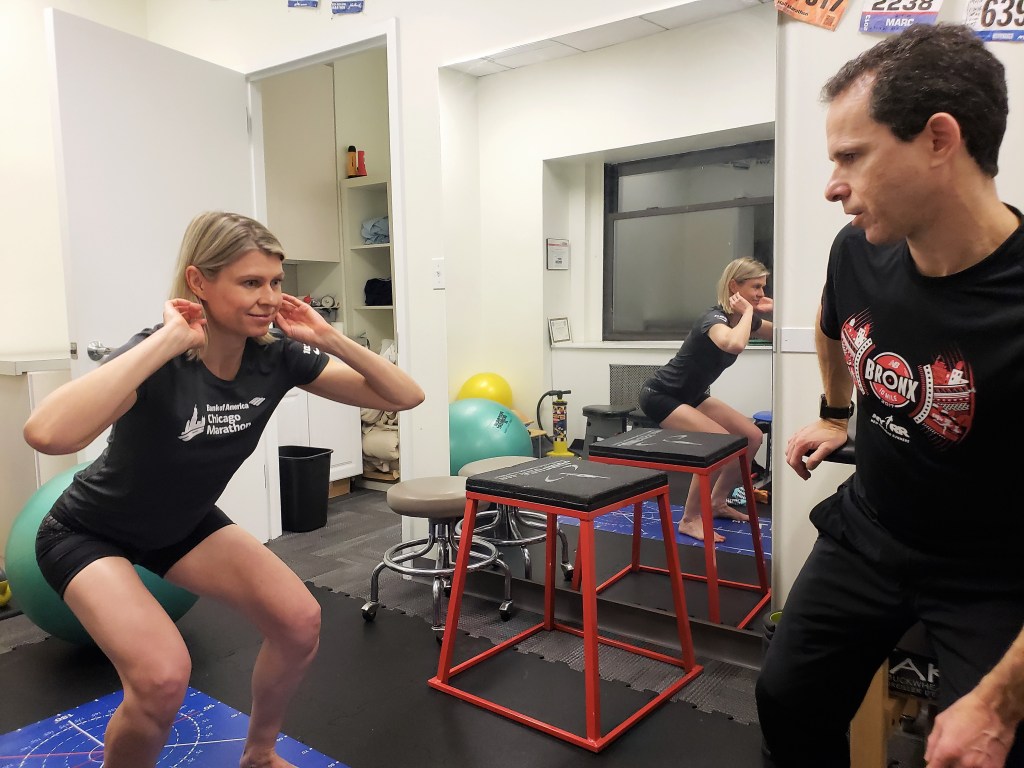
As members of a bike team that would quite prefer more watts than less, my teammates and I enlisted the help of Dr. Marc Bochner from Bochner Chiropractic to teach us a solid prehab routine. Marc has been treating amateur and professional athletes in the NYC area for over 20 years. I’ve personally needed him so much that I wouldn’t still be training without him; our resulting friendship has been a major upside.

Prehab(ilitation) refers to the self-care routine we can follow on a periodic basis to monitor and treat our weak links, before injury takes place. Depending on the state of our bodies, such routine can require a series of professional treatments, or simply take 10-15 minutes before each workout. Marc has developed a program called Prepare to Compete that provides athletes with a simple but structured approach to such injury prevention. This program is designed to maintain and/or improve three key areas, as follows.

Posture (also called form)

Good posture implies that the body at initiation of movement is in a strong, balanced position. The key limiters are tight or injured muscles so key protocols here are:

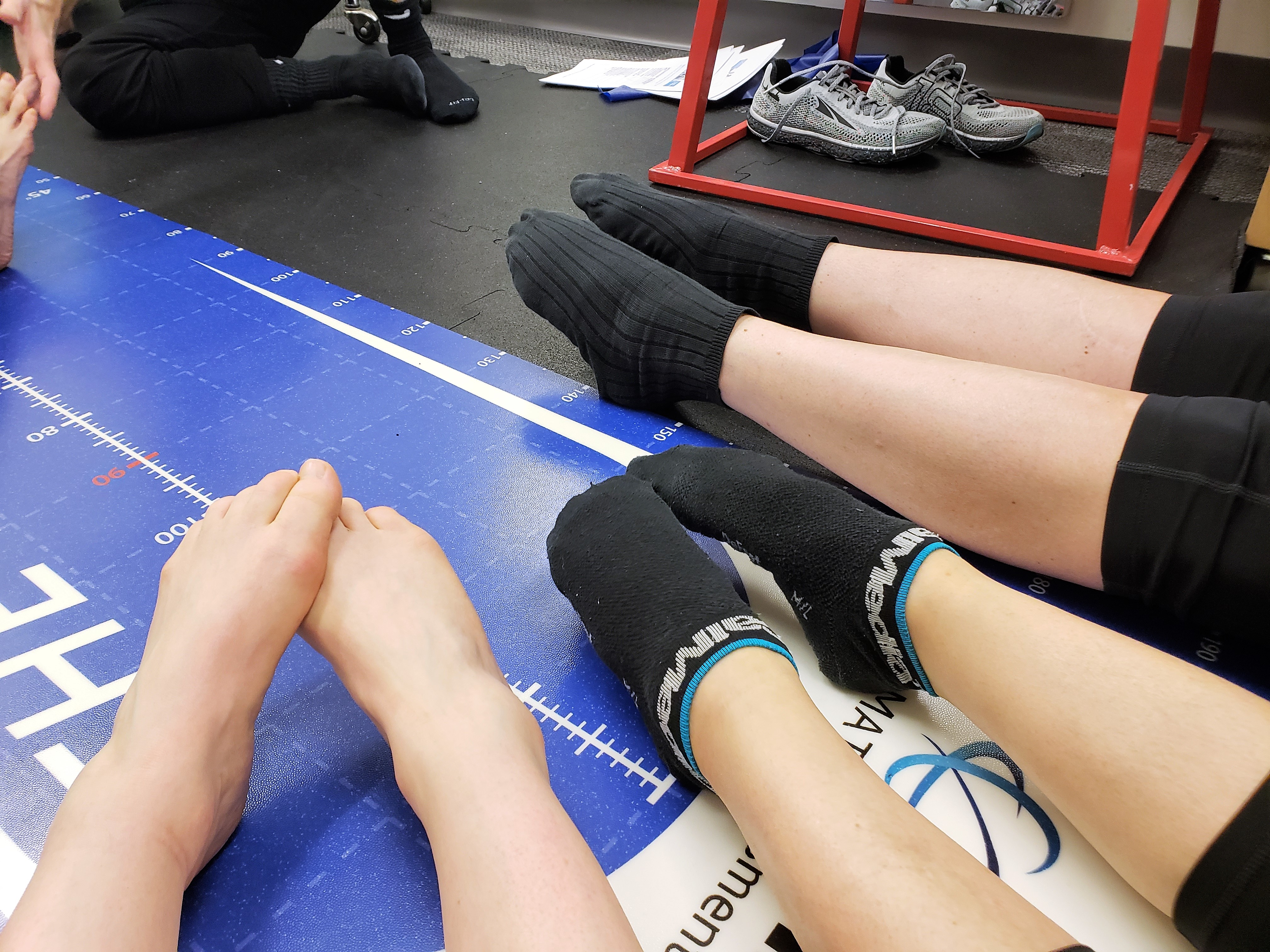
Testing for tightness – doesn’t look wonky to me

Range of motion (also called tension, flexibility, or mobility)

Good flexibility means that we can move muscles and joints through their full range of motion such that force production can be optimally converted to power. One often-overlooked aspect of this is our breathing – without proper breath technique the deep stabilizing muscles won’t activate; furthermore, poor breath technique can reinforce poor posture and muscle tension. Self-care exercises should include:

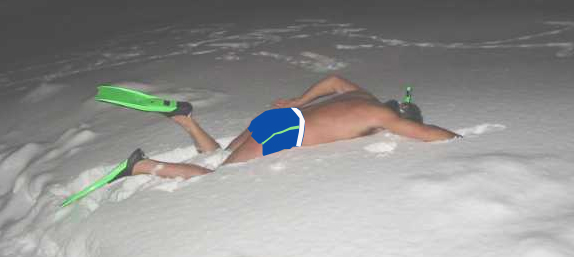
With this awesome amount of flexibility, we could be a swim team

Movement control

A high quality of movement control implies efficiency of muscle recruitment. For example, when you move your leg backwards from the hip, the gluteus maximus and deep core should contract first, not the superficial lower back muscles. This avoids excessive strain on a single muscle which was not designed to carry out that movement in isolation; it also means greater force production. Seven key exercises require maintaining the first two concepts above through movement:

  1. Rocker board balancing
  2. Single-leg standing (with or without eyes closed)
  3. Standing knee hug
  4. Lunges (front, side, rear, front with rotation & oblique)
  5. Side raises
  6. Single leg squats
  7. Push ups
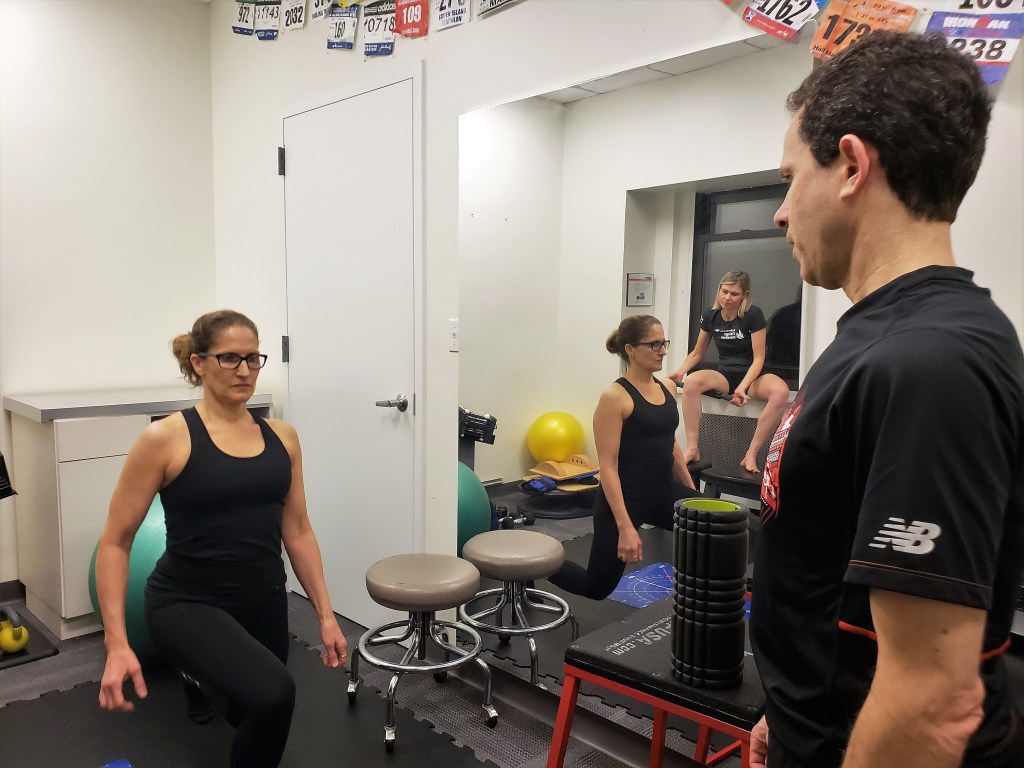
The perfect lunge by a kick-ass sprinter

How prehab links to bike fit

I can’t explain better than this blog post from Fit Werx. Posture breeds comfort; flexibility aids aerodynamics; movement control generates power.

Positive reinforcement through daily activities

A key point I often forget is that while it’s all well and good to practice good movement patterns as part of our workout routine, about 90% of our days is actually spent doing other stuff, and that other stuff often involves a lot of sitting or standing around with plenty of room for reinforcement of bad postural habits.

  • The dangers of sitting have been well documented. Luckily Marc provides some handy desk exercises that can help without looking too silly.
  • A bus or subway commute is also a great time for a few exercises:
    • reinforce good posture by fully engaging the core and upper back muscles
    • stand on one leg for 30 seconds at a time
    • practice glute engagement (squeeze your butt)

You never know, that last one might also land you a date.

How To Train Your Husband, Part II

In How To Train Your Husband, Part I, I describe how I set out to use my husband as a coaching guinea-pig for a month. The idea was to get him back into training and to give myself a sense of what being a coach would be like. In this post I look back at the results and figure out lessons learned.

Did we achieve his objectives?

Yes – pretty much, sort of!

Obj. 1 – Achieve some consistency of training again – specifically, two workouts per week for each of swim/bike/run and strength.

              We got there! The first week we missed a swim and run but got consistency the next two weeks. The final week was derailed by a cold. Overall, 72% of workouts were completed. All credit for this goes to my husband, who re-evaluated his working hours to make time for working out.

Obj. 2 – Complete swim workouts of no less than 30 minutes each, and be able to swim 500-600m steady continuous

              Achieved! First swim, he came back saying that every lap felt like hard work. Last swim, he completed 1500yds including some 50’s at a harder effort, and “felt good”.

Obj. 3 – Be able to run a minimum of 5 miles continuously, i.e., no walk-run

              Nearly! We got to 5 miles with breaks for stretching. We did get out of the “this hurts and I have to walk now” mentality, and whereas week 1 I got a frowny face as comment, by week 4 I got the happy face. Turns out the mantra we put in place, “one step at a time”, was hugely valuable here, as was ensuring time set aside for proper warm-up.

Obj. 4 – Do not, under any circumstance, buy cheese

              Fail! Mostly because when it came my turn to cook, I bought pizza. Naughty coach.

The nicest part for me was to see how the motivation grew over time, with one small workout success feeding the next. As example, the first early morning strength workout I’d planned, I laid out his kit the night before, set the alarm, made coffee, dragged him out of bed, and went through the routine with him one exercise at a time. Fast forward to week 3…an hour after the alarm goes off, I stumble into the living room to find him standing on one leg surrounded by different color resistance bands, telling me to “stop talking, I’m in my focus zone”. Nice, hon!

Which brings me to the one argument we had…it was single-digit temperatures outside, and he came home early evening having worked outside, had a bad day, then got his muscles kicked by our ART practitioner.

“Doctor worked my muscles, so I can skip my swim, right?”

“No. He worked your legs. Swimming uses arms. You should get to the pool now.”

In the ensuing argument, the funniest thing was that I couldn’t tell if he was upset at me because I was his coach, or his wife…if I kick you out the door at 8pm to go swim in 5-degree weather, is that tough love coaching or just being a crappy wife? In this instance it happily turned out to be the former, as he finally left to get it done and came back with a smile. Phew.

I forced my husband to get to the pool no matter what

Lessons learned

  1. Coaching is hard! Kudos, coach-people
  2. The critique from my husband was that I did not allow for enough rest days. In particular, as we ended up going away for a weekend I took away his usual (Monday) rest day to shoehorn in the required number of workouts, thinking it was do-able given the relatively easy workout schedule. That was a mistake because a) I was under-estimating the cumulative muscle fatigue associated with the run workouts; and b) I was not factoring in that recovery days shouldn’t just be for muscle recovery but also for mental recovery and general rest & relaxation. Unsurprisingly, that mirrors the same mistake I make with my own training
  3. You can’t impose what you would do on other people. The right “pace” of progression is unique to each person, and you need to meet people where they are. For example, I put structure in certain workouts to give a boost to fitness gains, but my husband didn’t always want to do them and I couldn’t talk him round
  4. In a similar vein, it seems important to give people space to figure out what works for themselves. My instinct is to try and be helpful, when the reality is that I’m just being overbearing…there’s a fine line between guiding and imposing that I find hard not to cross.

And finally…I really like coaching. Time to study!